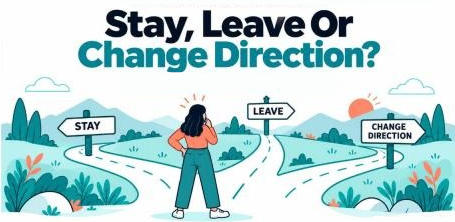
There comes a time when we question the direction our career is heading. You might find yourself at a crossroads when it comes to your career. With 2027 not that far away, you could be feeling uncertain about your next career step. What does it mean to reach a career crossroads? You know that something needs to change with your work, but you don't know what. You might be unhappy in your current role but unsure whether you actually want to change your career. This is why making a career decision can feel so difficult, and you end up avoiding making a choice.
You might be thinking to yourself: Should I stay, leave or change direction?
Another thought could be: I know what I don't want, but I don't know what I want to do. What usually happens is that you end up staying, waiting for inspiration, motivation and clarity to happen. What often gets in the way is perfectionism and procrastination. You self-sabotage. You could make excuses, saying you are busy, have other commitments or will do it later. Time goes by and opportunities continue to be missed when you stay still.
It is important to recognise the signs when something doesn't feel right or is no longer working. These signs could include feeling stuck, frustrated or unfulfilled in your role. You are losing motivation and enthusiasm for your job. You can feel disconnected from your work and question whether your position still meets your needs. You might find yourself repeatedly thinking about leaving or doing something completely different. It could be changing careers, starting a business or even travelling and exploring the world. There can be a feeling that something is missing in your life, that you are tired of being on the hamster wheel and no longer want to live like this.
What keeps you stuck or is holding you back?
Often, fear is what gets in the way. Fear of making the wrong decision, losing financial security, or worrying about the opinions of others and what they might say or even laugh at you. Questioning yourself over and over can lead to further self-doubt and a lack of confidence. You might also be waiting for the perfect time or someday to make a change.
The most common reason I hear that keeps people where they are is that they feel they have invested too much time in their career and, if they walk away, they will have wasted that time. This is known as the sunk cost fallacy, which relates to the initial time, energy, commitment and investment that you put into your career. Years of studying, exams, training, money, experience and hard work can make the idea of changing direction feel even more difficult.
How do I address the career crossroads problem?
First, you need to understand what matters most to you. Start by identifying your core values, which are like your personal compass. Core values help make decision-making easier and clarify what is most important to you. Your values help bring meaning, purpose and direction into your life. They can help you answer questions about what kind of work, company, team and sector you want to be part of. More importantly, values also help clarify what is not important to you, so you can stop wasting time and energy on things that drain you.
Take time to understand your strengths, skills and interests. Some questions to consider:
What motivates, fulfils and inspires you?
Has your definition of career success changed?
Are you considering what you actually want to do or what you think you should be doing?
Check whether your motives are internal or external. There is nothing wrong with career ambition, but be careful that you are not blinded by it.
Exploring Your Options
You do have options and choices available to you. Even if you decide to do nothing and remain at a career crossroads, you are still making a decision, whether you are aware of it or not. Let's examine some questions you need to answer if you decide to stay, move on or change your career.
1. Stay and make changes
If you want to stay, you will need to consider making changes to how you work and communicate, including your perception of the situation and how you can take responsibility for it.
Some questions to consider when staying:
Could renegotiating your scope of responsibilities, workload or working arrangements improve things?
Could having better boundaries or a conversation with your manager help?
Is there an opportunity for career development or progression?
By asking these questions and following up on them, you could solve the problem you are experiencing before deciding to leave.
2. Leave and find another role
Leaving to find another opportunity and a better role is another option. Some important questions to ask are:
Would another company offer a better environment and pathway to progression?
Are your frustrations related to your current employer rather than the profession?
What would you want from your next role and why?
3. Change your career direction
When deciding to change your career, this often takes the most courage and might need some planning, particularly if you are only getting started. Some questions to ask yourself are:
Are you interested in a complete career change or pivoting into a different area?
What transferable skills and experience do you already have?
Would further training, education or experience be required?
What opportunities could you explore and try before making a commitment?
Challenging Your Thinking and Beliefs
Limiting beliefs are often the hidden thoughts that can keep a person from pursuing the career they want or keep them stuck in a job they are unhappy in. They need to be brought from the unconscious to the conscious. We need to challenge them, reframe them and develop more empowering narratives about how we see ourselves.
Where do limiting beliefs come from? Often, they come from early childhood experiences, conditioning, school, bullying or possibly a bad workplace environment. Wherever the limiting belief came from, it can be impacting our career decisions today. We could potentially be looking at the world through the lens of how we saw it as a child instead of as an adult.
Do you find yourself saying any of the following?
"It's too late to change career."
"I've invested too much time to start again."
"I'm not qualified to do anything else."
"What if I make the wrong decision?"
"I should be grateful for what I have."
When you say these kinds of things to yourself, ask whether they are facts, assumptions or based on fears.
Moving From Thinking to Taking Action
Nothing changes if nothing changes. When you start taking action to come to a decision, you are beginning to take personal responsibility for the situation you are in. Moving forward could involve researching your options, speaking to people working in areas that interest you, or identifying transferable skills and potential skills gaps. You will need to consider potential courses, training, volunteering or work experience. Making progress is a lot easier when you break the action steps into smaller stages. Put your focus and energy into what you can influence rather than trying to control every outcome.
Making Career Decisions With Confidence
The most common mistake that keeps people stuck in their careers is waiting for clarity to happen before taking action. It is the other way around. Action develops confidence, which leads to clarity. You don't need to have every answer before you start. Accepting that there will be uncertainty can help you move forward and acknowledge that it is part of the process. Take time to reflect on what you have learned as you explore your options and possibilities. Be aware of when staying is a choice and when it is simply easier to avoid change.
Questions to Reflect On
What is not working in my career right now?
What options have I not explored yet?
What is one practical action step I can take next to move forward?
You Have More Options Available Than You Think
You're allowed to change your mind when it comes to your career. You don't need permission from anyone except yourself to change your career direction. If your job is no longer fulfilling or exciting, you can look for a new one. There is no single career path or timeline that must be achieved. The actions we take in life will shape the direction of our careers.
If you are at a career crossroads, questioning whether you should stay, leave or change direction completely, you could be feeling a number of different emotions and be unsure what to do next.
I've created the Career Crossroads Scorecard, which helps you reflect on where you are, identify one area that could be holding you back and consider one decision you can take to move forward.
You can download the Career Crossroads Scorecard through the link below.